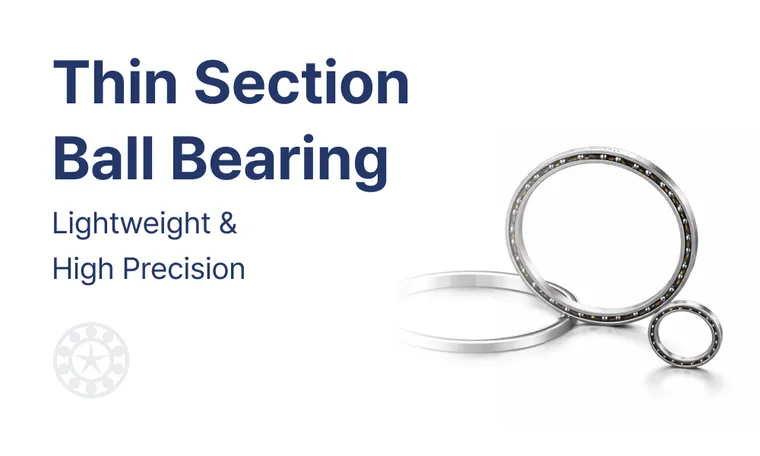
박형 볼 베어링은 씬월 볼 베어링, 슬림 볼 베어링 또는 슬림라인 베어링으로도 불리며, 매우 낮은 회전 소음과 높은 하중 지지 능력을 갖춘 고정밀 제품입니다. 박형 볼 베어링은 공간이 제한적이고 중량이 중요한 어플리케이션을 위해 디자인됐으며, 컴팩트하고 경량화된 솔루션을 제공합니다.
What Are Thin Section Ball Bearings?
박형 볼 베어링이란?
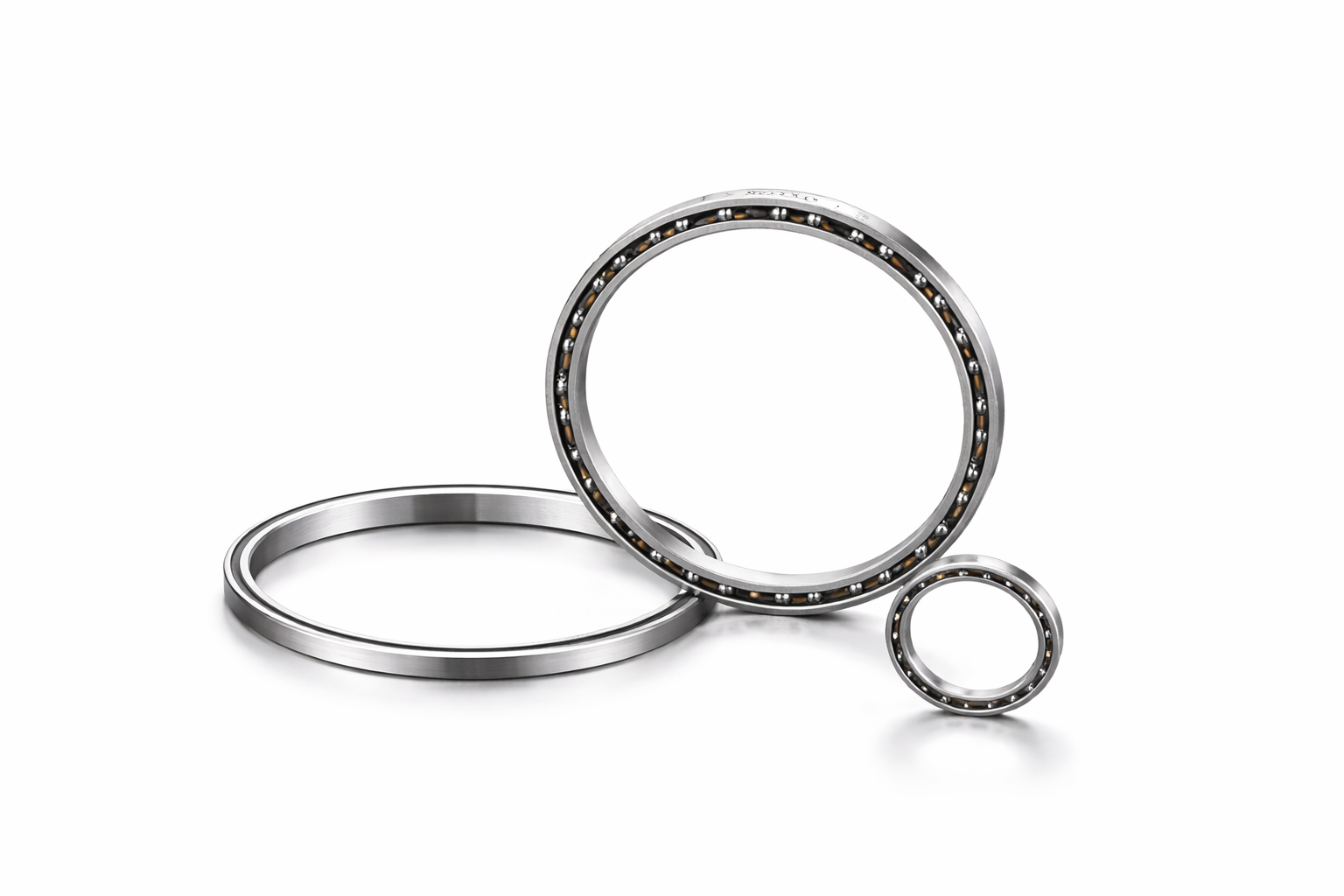
Thin section ball bearings are high-precision bearings designed for applications where space and weight are critical. Unlike standard ball bearings, they maintain a constant cross-section regardless of bore diameter, allowing compact designs without compromising performance.
This unique structure enables engineers to achieve high load capacity, excellent rotational accuracy, and stable performance even in limited installation spaces. As industries continue to demand miniaturization and lightweight solutions, thin section ball bearings have become essential components in modern engineering systems.
박형 볼 베어링은 공간 제약과 경량화가 중요한 환경에서 사용되는 고정밀 베어링입니다. 표준 볼 베어링과 달리 내경이 증가하더라도 단면 치수가 일정하게 유지되는 구조를 가지고 있어, 성능을 유지하면서도 설계 공간을 최소화할 수 있습니다.
이러한 구조적 특징은 제한된 공간에서도 높은 하중 지지 능력과 우수한 회전 정밀도를 확보할 수 있도록 하며, 최근 산업 전반의 소형화 및 경량화 요구에 따라 핵심 부품으로 활용되고 있습니다.
Key Features of Thin Section Ball Bearings
박형 볼 베어링의 주요 특징
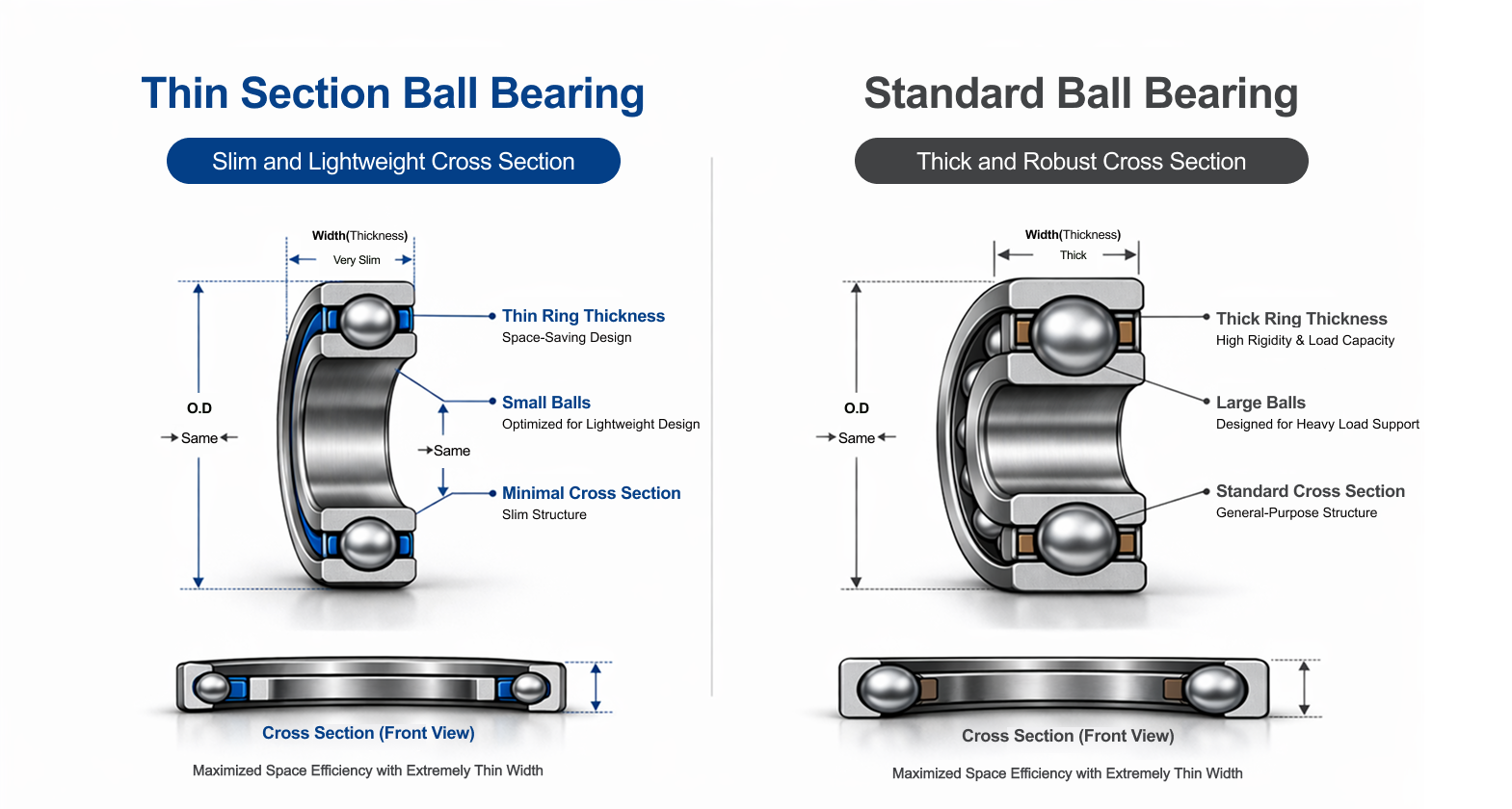
Thin section ball bearings are engineered to deliver high performance in compact assemblies. Their design focuses on optimizing space efficiency while maintaining precision and reliability.
- Compact design for space-constrained applications
- Lightweight structure for reduced system weight
- Constant cross-section regardless of shaft diameter
- High precision suitable for tight tolerances
- Low friction and smooth, quiet operation
These features make thin section bearings ideal for systems where both performance and space efficiency are required.
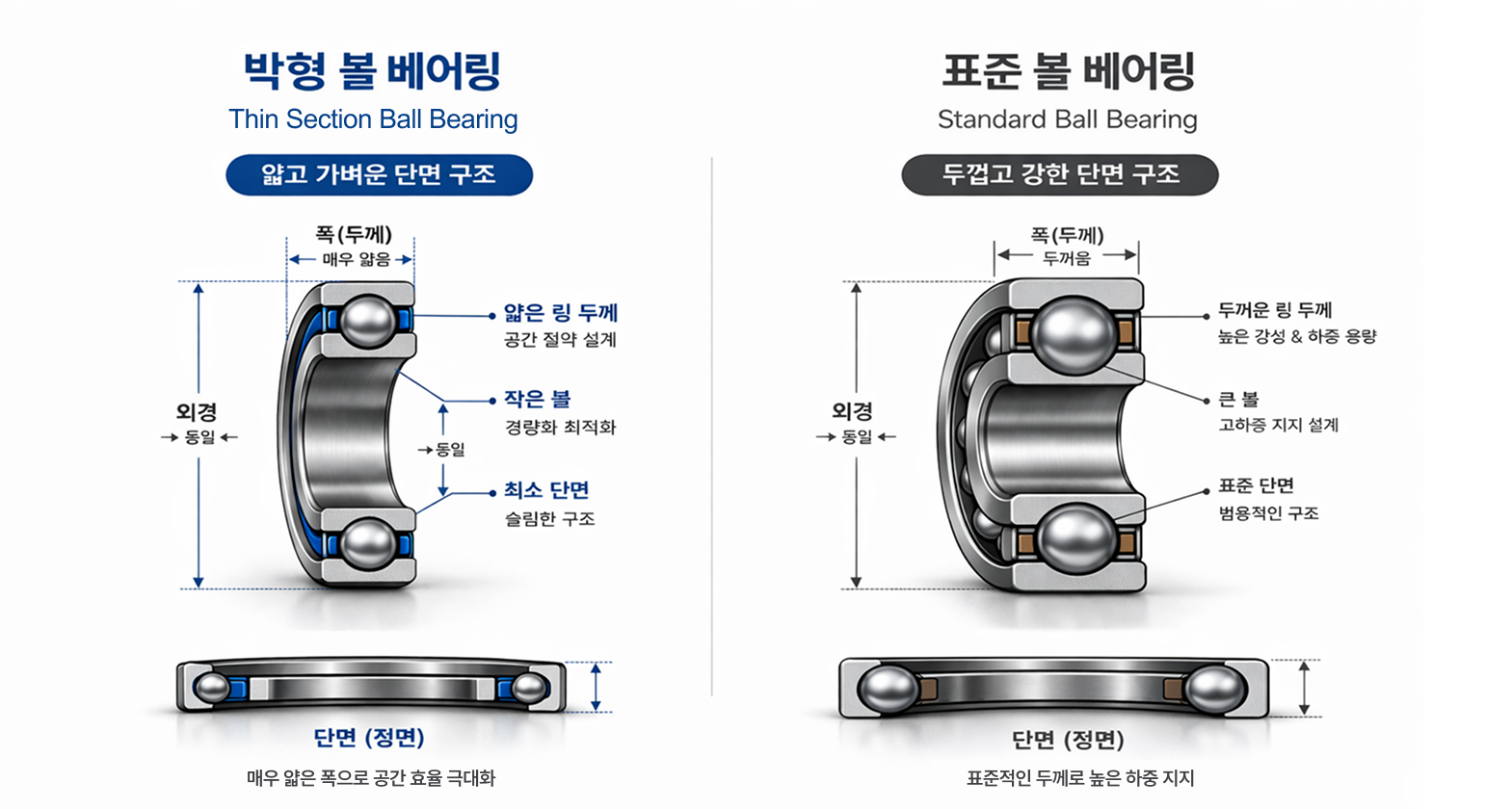
박형 볼 베어링은 제한된 공간에서도 높은 성능을 발휘할 수 있도록 설계된 베어링입니다. 공간 효율성과 정밀도를 동시에 확보하는 것이 핵심 설계 방향입니다.
- 제한된 공간에 적합한 콤팩트한 구조
- 시스템 경량화를 위한 가벼운 설계
- 샤프트 직경과 관계없이 일정한 단면 구조
- 엄격한 공차 대응이 가능한 높은 정밀도
- 저마찰 및 저소음의 부드러운 회전 특성
이러한 특성으로 인해 성능과 공간 효율성이 동시에 요구되는 시스템에 최적의 솔루션으로 활용됩니다.
Applications of Thin Section Ball Bearings
박형 볼 베어링의 적용 산업

Thin section ball bearings are widely used in industries that require compact design and high precision.
- Aerospace systems requiring weight reduction and reliability
- Robotics and automation equipment demanding smooth and precise motion
- Medical devices such as surgical robots and diagnostic systems
- Semiconductor manufacturing equipment requiring ultra-high precision
- Optical and measurement instruments where accuracy is critical
In these industries, thin section bearings enable engineers to optimize system layouts while maintaining high mechanical performance.
박형 볼 베어링은 공간 제약과 고정밀 요구가 동시에 존재하는 다양한 산업에서 사용됩니다.
- 경량화와 신뢰성이 중요한 항공우주 산업
- 정밀 구동이 필요한 로보틱스 및 자동화 장비
- 수술용 로봇 및 진단 장비 등 의료 기기
- 초정밀 가공이 요구되는 반도체 제조 장비
- 높은 정확도가 필요한 광학 및 측정 장비
이러한 산업에서 박형 볼 베어링은 콤팩트한 설계와 높은 기계적 성능을 동시에 구현할 수 있도록 합니다.
Why Thin Section Ball Bearings Are Important
박형 볼 베어링이 중요한 이유
Modern engineering increasingly prioritizes space optimization, weight reduction, and energy efficiency. Thin section ball bearings directly support these objectives by enabling more compact designs while maintaining high performance.
They help reduce material usage, improve system efficiency, and enhance performance in precision applications. As a result, they are becoming indispensable in industries where design constraints and performance requirements must be balanced.
현대 엔지니어링에서는 공간 최적화, 경량화, 그리고 에너지 효율이 중요한 설계 요소로 강조되고 있습니다. 박형 볼 베어링은 이러한 요구를 충족시키면서도 높은 성능을 유지할 수 있도록 돕는 핵심 부품입니다.
자재 사용량 감소, 시스템 효율 향상, 그리고 정밀 어플리케이션에서의 성능 개선을 가능하게 하며, 설계 제약과 성능 요구를 동시에 만족시켜야 하는 산업에서 필수적인 요소로 자리잡고 있습니다.
Market Trends and Industry Outlook
시장 동향 및 성장 전망
According to the Thin Section Ball Bearings Market Research Report by MARKET RESEARCH FUTURE, the global market was valued at USD 7.39 billion in 2024 and is projected to grow from USD 7.70 billion in 2025 to USD 11.07 billion by 2034, with a CAGR of approximately 4.12% during the forecast period.
This growth is driven by increasing demand for automation, robotics, and precision equipment across industries. In particular, ultra-precision thin section ball bearings such as P5 and P4 class are expected to see continued demand in applications requiring high accuracy and reliability, including machine tools, medical devices, precision instruments, and optical systems.
MARKET RESEARCH FUTURE의 박형 볼 베어링 시장 조사 보고서에 따르면, 글로벌 시장 규모는 2024년 약 73.9억 달러로 평가되었으며, 2025년 77억 달러에서 2034년에는 약 110.7억 달러까지 성장할 것으로 전망됩니다. 예측 기간 동안 연평균 성장률(CAGR)은 약 4.12%로 예상됩니다.
이러한 성장은 자동화, 로보틱스, 정밀 장비 수요 증가에 의해 견인되고 있습니다. 특히 공작기계, 의료기기, 정밀 계측기, 광학 장비 등 높은 정밀도와 신뢰성이 요구되는 분야에서 P5 및 P4 등급의 초정밀 박형 볼 베어링 수요는 지속적으로 증가할 것으로 예상됩니다.
What’s Next: Manufacturing of Thin Section Ball Bearings
박형 볼 베어링 제조 공정
In upcoming articles, we will explore the manufacturing process of thin section ball bearings, their advantages and limitations in more detail, and how ORSKOREA delivers tailored solutions for specific industrial needs.
향후 게시될 글에서는 박형 볼 베어링의 제조 과정, 주요 장점 및 한계점에 대해 더욱 상세히 다룰 예정입니다. 또한, 다양한 산업 분야의 특수한 요구사항에 대응하기 위해 오알에스코리아가 제공하는 맞춤형 솔루션에 대해서도 깊이 살펴보도록 하겠습니다.